
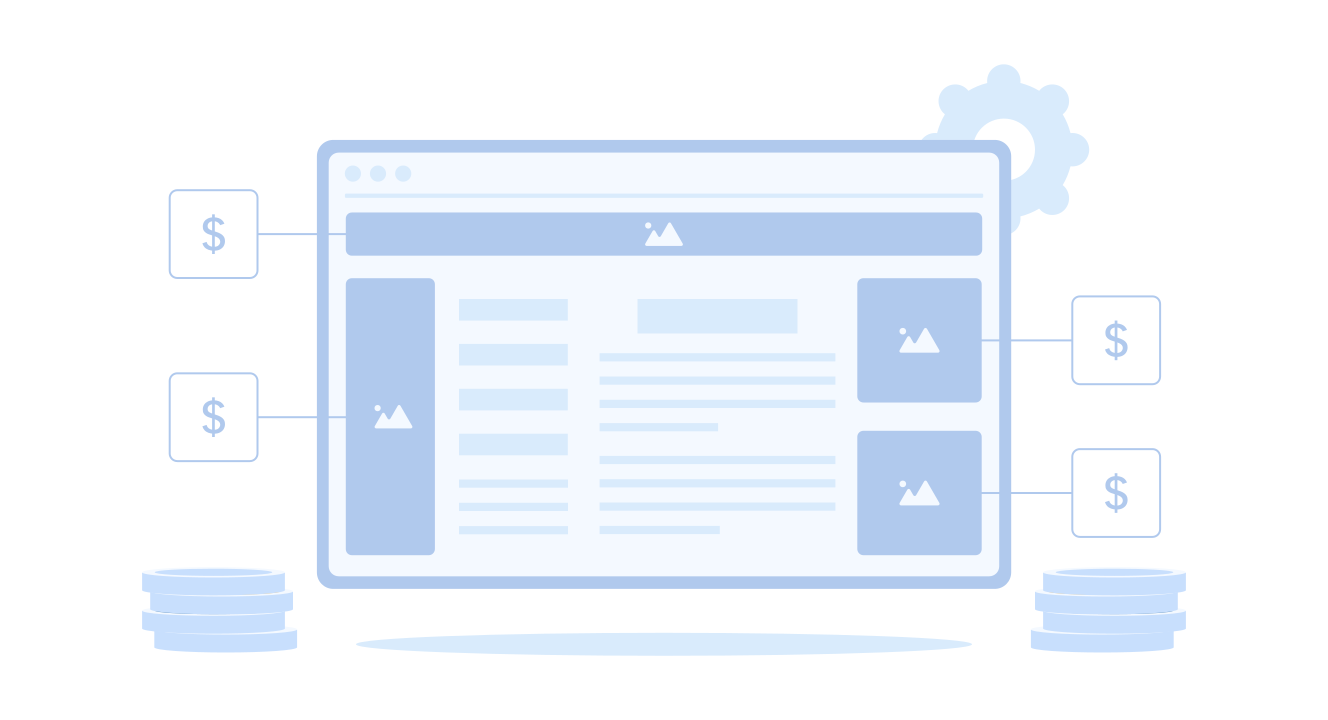
While ad tech is filled with many revenue-generating possibilities and solutions, ad mediation has been in the spotlight for over a decade. It allows publishers to sell their ad inventory to those with whom they align regarding brand cohesion and target audience.
In today’s article, we discuss everything you need to know about ad mediation, from what it is to how it works and the benefits of such a solution.
Without further ado, let’s get started!
Table of contents
What Is Ad Mediation and How Does It Work?
Ad mediation is integral to the ad tech industry and is used by publishers to generate revenue through a single interface while managing multiple ad networks and demand sources.
Programmatic technology, such as ad mediation, could help publishers monetize their ad slots through increased display fill rates, CPM, eCPM rates, user targeting, and other metrics.
Therefore, the ad mediation and mediation platforms can customize which ad networks they aim for to sell their ad inventory, thus sending ad requests to increase their fill rates in a specific order.
This advertising technology ensures publishers sell their ad inventory by rotating the slots and switching between different ad networks and demand sources to maximize ad revenue. The process happens in real-time, and decisions are made on the spot based on performance data and available requests.
How Ad Mediation Revenue is Calculated
Ad revenue = Ad requests * fill rate * eCPM
- Ad revenue, just as the name suggests, is the publishers’ earnings;
- Ad requests are the number of ad units requested. How many competitors bid for a publisher’s ad space whenever visitors enter their website or platform?
- Ad fill rate is a metric that measures the ad network’s performance. It is calculated by how often an app or website has requested an ad from the ad network.
- eCPM, also known as the Effective Cost Per Thousand Impressions, directly translates to how much an advertiser pays for an ad slot for 1000 impressions.
Thus, ad mediation aims to optimize the fill rate, eCPM, or both to increase the highest ad revenue, meaning ROI.
What Is an Ad Mediation Platform?
As briefly mentioned, the ad mediation request can be made in a particular order, depending on publishers’ liking and expected ad revenue. So, if their top choice isn’t available to fill out the request, the ad mediation platform considers the following ad network.
Furthermore, the ad mediation platforms could test different CPMs and fill rates or even offer auto-optimizing mechanisms to increase revenue through waterfall and header bidding.
Here’s the catch for businesses new to ad tech: header bidding is the latest update to the waterfall bidding process. As such, it is essential to see a breakdown of these two.
Header Bidding vs. Waterfall in Ad Mediation
Header bidding is a monetizing model through which publishers sell their ad space by simultaneously collecting numerous bids from different demand sources, such as ad exchanges, ad networks, demand-side platforms, and supply-side platforms.
On the other hand, the waterfall auction presumes that a publisher’s inventory is passed down from one demand network to another meaningfully according to importance until the ad inventory is sold.
Both bidding processes imply that the ad inventory is sent to one demand source at a time, which, as you already guessed, is time-consuming since the highest bid should be above the publisher’s floor price. This process repeats until the ad inventory is sold.
Another alternative could be the Real-Time Bidding (RTB) auction system, which buys and sells ad space in real time based on impressions. So, let’s find out more about it and how it could benefit publishers.
What is Real Time Bidding (RTB), and How Does it Work?

First, it is essential to mention that header bidding and waterfall bidding are subsets of RTB.
Real-Time Bidding (RTB) is a derivative of programmatic advertising, whereby multiple advertisers quickly auction to secure the ad space when a user accesses a website or mobile application. Thus, the highest bidder wins, making it more efficient and yielding a higher return on investment.
Furthermore, Real-Time Bidding (RTB) is used by publishers and advertisers within supply-side (SSPs) and demand-side platforms (DSPs), as well as ad exchanges, to sell their ad inventory cost-effectively and promptly.
Indeed, RTB might seem like a complicated process, yet it benefits publishers by increasing return on investment and maximizing the selling of ad space.
Furthermore, a supply-side platform like Sevio Ad Manager simplifies the process while being an ad mediation alternative. It is specific and offers a blend of advanced technology with easy-to-understand analytics, helping publishers maximize their ad inventory.
Furthermore, a supply-side platform enables ad networks and demand-side platforms to bid on the available ad space, allowing publishers to benefit from an automated process for selling their inventory and CPMs.
How Does the RTB Process Work?
Everything happens in just a few seconds: the bidding, the allocation, and the displaying of the ad deliverable.
So, whenever a visitor accesses a publisher’s web page or an application, it triggers a specific ad placement based on the user’s IP address and operating system, besides the ad format and price.
Since the publisher made his ad inventory accessible, the SSP notifies advertisers of the details about the visitor to evaluate the auction details.
Moreover, the automated algorithm evaluates the highest bid based on advertisers’ requirements, meaning the demand-side platform and the ad campaign are displayed if it is also relevant to the visitor.
Since this is a complex process, RTB cannot be calculated through a single formula, as seen in ad mediation.
However, a supply-side platform like Sevio Ad Manager uses some of the most common pricing models, such as the CPM (Cost-per-Mille, also called Cost-per-Thousand Impressions), CPC (Cost-per-Click), or CPD (Cost-per-Day).
Each model brings different advantages, from publishers getting paid for every one thousand ad displays, the ad’s number of clicks, or a fixed amount for advertisers’ ads to be displayed for a full day.
While ad mediation focuses on finding the highest-quality ad networks, SSPs like Sevio Ad Manager leverage RTB to find the highest-paying advertisers for each impression.
Ad Mediation vs. RTB: Benefits and Drawbacks

As we’ve learned what an ad mediation is, how it works, and its alternative, the RTB auction system, it’s time to move along and break each one down in terms of pros and cons.
What Are Ad Mediation’s Benefits?
Using ad mediation and ad mediation platforms has several advantages, and in the following paragraphs, we discuss the benefits for publishers’ business apps and websites.
1. High Competition Among Various Ad Networks
The increased competition is probably the most important benefit for any publisher wishing to increase their revenue.
As such, when a publisher uses ad mediation to sell their ad inventory, they set themselves up for a bidding contest, in which many ad networks often increase their initial bids in the mists of beating the competition and winning the ad space.
2. Higher Fill Rates
Indeed, there are differences between the ad networks; some might deliver more, while others fall short. An ad mediator allows a publisher access to wider ad networks, thus potentially increasing their fill rates and earnings.
3. Increased CPM
Ad mediation platforms enable publishers to increase CPM by connecting through multiple ad networks. The better the competition, the better the CPM rate.
So, ad mediation increases the competition, which translates to better ad space revenue.
What Are Ad Mediation’s Drawbacks?
Of course, as with any ad tech solution, we must consider the drawbacks.
1. Lagging Apps and Websites
As you expose yourself to multiple ad networks, your source code will make your platform size grow, which could lead to potential lagging effects. Not to mention that integrating the ad mediation is a more complex and technical process that requires additional knowledge.
2. Bias
It’s common to see ad mediation platforms that are also ad networks.
However, this could be detrimental, as many could serve your ad spaces to their network rather than find the best options from multiple networks.
What Are RTB’s Benefits?
Let’s explore the publisher’s and advertisers’ benefits that make Real-Time Bidding (RTB) a true ad mediator contender.
1. Automated Process
We think this is one of the most essential benefits for publishers and advertisers, enabling them to fast and automated ad space selling.
On the one hand, it enables fast ad space purchasing for advertisers and gives them greater control. On the other hand, with the help of an SSP, publishers find suitable demand sources quickly and easily.
2. High Revenue Potential
Real-Time Bidding is an auction system that offers publishers a high revenue potential by selling their ad inventory. With the right SSP, like Sevio Ad Manager, publishers can sell their unsold ad space at a higher price, adjusting their prices based on the demand and bids.
3. Tailored Ad Spaces
Real-Time Bidding is used for more than just generating revenue quickly and easily, especially when publishers enable advertisers to advertise their offerings to the right audience.
As we already know, it is essential to advertise the right message at the right time to the right audience, as this increases brand awareness and revenue growth.
Moreover, with a partner like Sevio Ad Manager, any publisher’s offerings reach its target audience in an engaging and non-intrusive way.
What Are RTB’s Drawbacks?
One disadvantage could be integrating SSPs; some require technical knowledge and expertise. However, this is not a general rule.
Therefore, Sevio takes it up a notch by ensuring brand safety through easy-to-use integration, interface, data privacy compliance, and anti-fraud tools.
What to Choose Between Ad Mediation and RTB?
Both options present pros and cons and choosing one ad tech solution heavily depends on your advertising goals and requirements. As mentioned, RTB offers an automated way of handling the ad space auction, and ad mediation offers a more hands-on approach.
But if you are still determining which option suits your business needs, let’s talk and learn how to turn your website into the main engine of your earnings!
Was this helpful?