
Most of us in programmatic advertising got comfortable with the division of labor. Advertisers used DSPs to plan and execute campaigns. Publishers relied on SSPs to manage inventory and maximize yield. There was an ad exchange in the middle, a verification vendor on top, and a measurement layer somewhere in the stack. That was the deal.
But that deal is now collapsing.
In early 2026, Microsoft officially shut down Xandr Invest, its demand-side platform. The company informed clients that the DSP would cease operations by February 28, 2026, citing a single core reason: the traditional DSP model “no longer aligns” with its vision for a private, personalized, and agentic advertising future.
But don’t think that Microsoft is walking away from advertising. It’s consolidating by merging buy-side capabilities into the Microsoft Advertising Platform, a single AI-powered buying system, while doubling down on its sell-side tools, Microsoft Curate and Microsoft Monetize.
That’s surely not a retreat, but a blueprint.
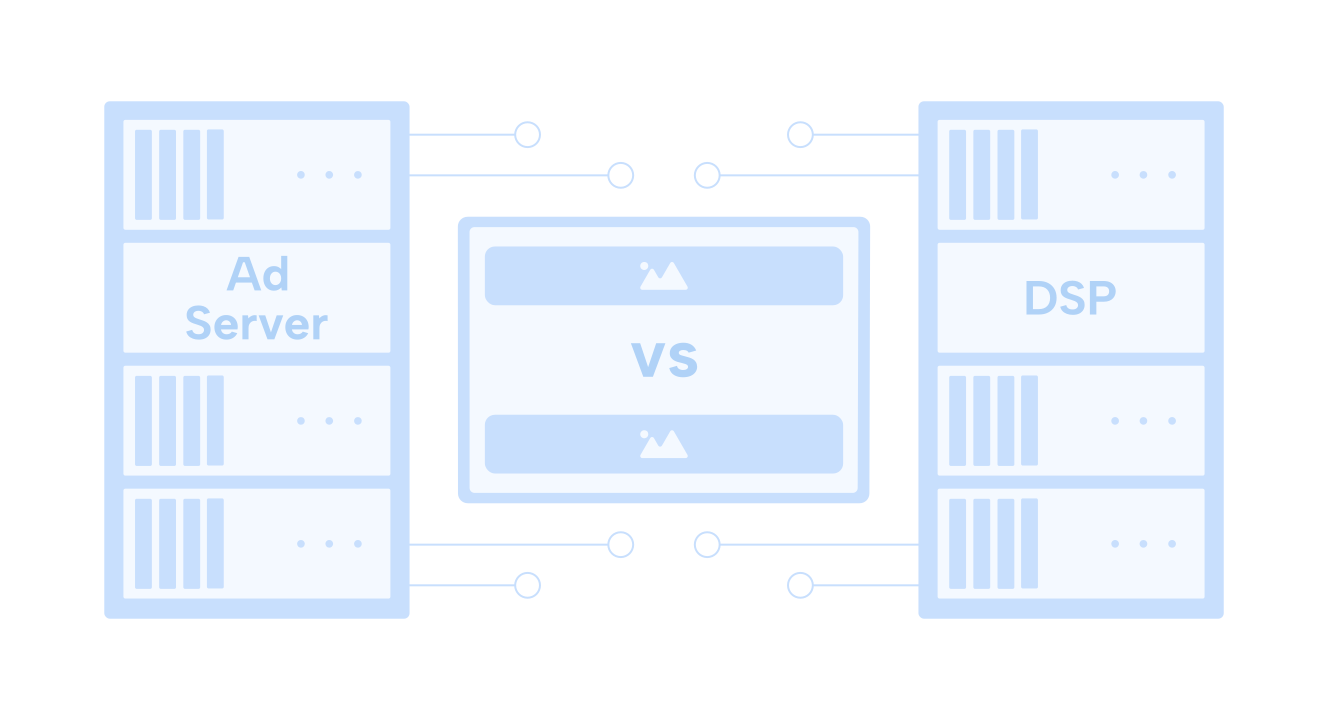
And if you work in programmatic, on either side of the supply chain, it raises a question worth taking seriously: Is the separation between DSPs and SSPs still meaningful?
Table of contents
- How We Got Here: The 15-Year Supply Chain That Broke
- What Convergence Actually Means: DSPs Becoming SSPs and Vice Versa
- The UAP: What It Is and Why It’s the Logical Endpoint
- What This Means for Publishers Specifically
- The Supply Chain Transparency Pressure Accelerating Convergence
- What a Converged Platform Looks Like in Practice
- Will Full Convergence Happen? What the Industry Is Saying
- What CTOs Should Do Now
- FAQ
- Final Words
How We Got Here: The 15-Year Supply Chain That Broke

Programmatic advertising was built on a clean division of labor. DSPs handled buying. SSPs handled selling. Ad exchanges connected both sides. For most of the 2010s, this worked.
The problem is that those layers kept multiplying. By the early 2020s, a single impression could travel through a DSP, multiple SSPs via header bidding, an ad exchange, a verification vendor, and a measurement layer before reaching a publisher’s page. Every hop extracted a fee. Every fee reduced the share of the advertiser’s dollar that reached a real human being.
The incentives made it worse. SSPs conveyed the same impression to multiple demand partners simultaneously, resulting in what became known as bid duplication.
DSPs responded with supply path optimization (SPO). SSPs added more layers in response. The arms race lengthened the supply chain, not shortened it.
That’s the supply chain that is now breaking.
This growing complexity is also one of the reasons why a new generation of publisher-focused platforms emerged over the last few years. Companies like Sevio began investing in unified monetization workflows to reduce operational fragmentation and help publishers regain visibility into how revenue flows through the supply chain.
What Convergence Actually Means: DSPs Becoming SSPs and Vice Versa

Convergence isn’t a trend companies are choosing to follow. It’s the market’s response to mounting inefficiencies, driven by inefficiencies on both ends.
The argument isn’t that DSPs and SSPs will disappear. It’s that their separation is becoming less meaningful as major platforms operate across both sides of the transaction.
On the demand side, The Trade Desk’s OpenPath is the clearest example. Launched in 2022 and expanded to CTV and audio in 2024, OpenPath creates a direct integration between The Trade Desk and premium publishers, bypassing the SSP layer entirely for those transactions. After adopting OpenPath for CTV programmatic, Vizio (now part of LG Electronics) reported a 39% increase in reserved programmatic revenue. The value that had previously leaked through the supply chain stayed with the publisher.
On the sell side, Magnite’s ClearLine took the opposite route. Originally launched in 2023 as a self-service tool for agencies to buy premium video inventory directly from SSPs, ClearLine was expanded in late 2025 to unify curation and activation in a single interface. A historically sell-side company is now operating in buy-side territory.
And then there’s the Microsoft case: not building both sides, but collapsing one side entirely and rebuilding around a unified platform that serves the advertiser through proprietary, AI-driven inventory pathways.
The pattern is consistent. The industry is moving away from “a DSP buys from SSPs which sell for publishers” and toward “a platform connects buyers and sellers with fewer, smarter intermediaries.”
Rather than building isolated tools for ad serving, sales management, and marketplace access, platforms such as Sevio have increasingly focused on connecting these functions within a single workflow, reflecting the broader industry push toward fewer, more integrated systems.
The UAP: What It Is and Why It’s the Logical Endpoint

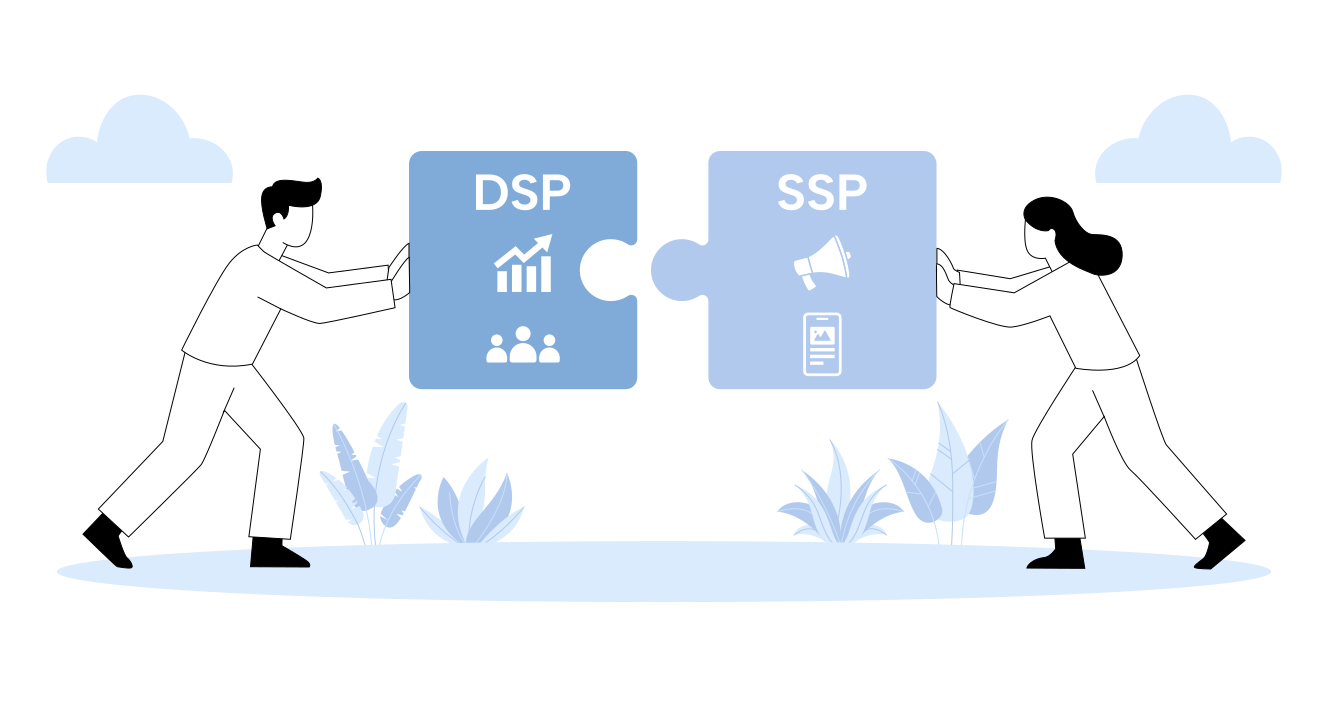
A unified advertising platform, or UAP, operates on both sides of the programmatic transaction, handling buying, selling, targeting, measurement, and optimization in a single system rather than through a chain of specialized tools.
Owning both a DSP and an SSP is not the same thing as being a UAP. Two separate tools, two separate data layers, two separate reporting dashboards under the same corporate roof… that’s diversification, not convergence. A true UAP means the advertiser’s campaign logic informs supply-side decisions in real time, and the publisher’s inventory signals flow directly into the buyer’s optimization models. It’s a closed loop, not a chain.
According to analysts at W Media Research, the industry is likely to converge on 10 to 15 global transaction platforms: four to five walled gardens, five to eight unified advertising platforms, and a smaller set of niche specialists. That’s a stunning consolidation from today’s ecosystem, where hundreds of DSPs and SSPs still compete for the same transactions.
That’s why the UAP is the logical endpoint of where this industry has been heading since SPO became a mainstream strategy.
What This Means for Publishers Specifically
Publishers have the most to gain and, potentially, the most to lose from SSP/DSP convergence.
Direct integrations reduce the fees intermediaries extract, allowing a larger share of the advertiser’s dollar to reach the publisher. The operational upside is just as real: fewer tools, cleaner reporting, and a single system replacing a fragmented stack.
But simpler infrastructure and fewer demand relationships are two very different decisions. A unified platform solves the first. Whether you maintain enough buyer diversity to keep auctions competitive is entirely up to you. Consolidating too fast means trading short-term simplicity for long-term revenue risk.
The Supply Chain Transparency Pressure Accelerating Convergence
If the Microsoft shutdown was a signal, the data is the confirmation.
According to the ANA’s Q2 2025 Programmatic Transparency Benchmark, approximately $26.8 billion in global programmatic media value is still lost annually due to redundant supply paths, measurement gaps, and low-quality inventory.
The same report found that the TrueCPM Index, a measure of the share of spend reaching quality impressions, dropped from 37.8% to 36.5% quarter over quarter, even as paid CPMs held steady. Advertisers are paying the same prices and getting less quality.
The report’s bright spots are equally instructive:
- Private marketplace transactions now account for nearly 88% of all programmatic spend, up from 64.5% the prior quarter.
- CTV’s share of programmatic spend jumped to 44%, but it also introduced new efficiency gaps, since CTV still lacks the measurement infrastructure of display.
The market is voting with its budget. Buyers want fewer, higher-quality supply paths. Sellers want more direct relationships with buyers. Both forces are accelerating convergence.
The same demand for transparency is also influencing how publishers evaluate their technology partners. Platforms that provide impression-level reporting, auction visibility, and direct insight into demand sources are becoming increasingly attractive, helping shape products such as Sevio’s Ad Manager.
What a Converged Platform Looks Like in Practice

Convergence doesn’t always begin with a platform operating on both sides of every transaction. More often, it starts with publishers asking a simpler question: Why are we still managing monetization across five different systems that barely communicate with each other?
Today’s publisher stack is often fragmented. A publisher might use one platform for ad serving, another for header bidding, a CRM for direct sales, spreadsheets to track campaigns, and separate dashboards for reporting. Every handoff between those systems creates duplicate work, inconsistent reporting, slower optimization, and more opportunities for revenue to slip through the cracks.
That’s exactly the operational complexity unified platforms are designed to eliminate. A unified platform addresses this by integrating inventory management, demand, sales, reporting, and optimization into a single workflow rather than treating them as separate products. That’s the approach Sevio has taken.
Developed by the team behind Coinzilla, Sevio brings these previously disconnected workflows into a single platform rather than asking publishers to stitch together multiple point solutions.
- Ad Manager handles ad serving, yield management, and unified auctions, with full impression-level visibility across both direct and programmatic demand.
- Marketplace connects publishers with buyers seeking preferential access to their inventory. Because it runs on the same platform as Ad Manager, buy-side data feeds directly into yield decisions in real time.
- Sales CRM manages the full direct sales pipeline, from proposals to insertion orders. When a deal closes, it flows automatically into Ad Manager: no manual re-entry, no lag between what sales promised and what delivery can see.
- Sales Representative gives smaller publishers access to an outsourced sales team, enabling them to compete for direct budgets without first building a dedicated in-house team.
The result is fewer handoffs, cleaner data, and a direct line between inventory and demand. As Tiberiu Stingaciu, CBDO at Sevio, puts it: “The industry spent years optimizing individual layers of the supply chain. Increasingly, the opportunity lies in connecting those layers more intelligently.”
Publishers running on a unified infrastructure describe the same shift. Anthony Ribeiro, CEO at CoinMarketCal (a crypto events and market-data platform), explains:
“A few years ago, we managed direct campaigns and programmatic monetization as separate parts of the business. Today, the biggest opportunity comes from connecting everything into a single workflow, from programmatic demand and direct sales to branded selling pages and self-serve marketplaces. Bringing these pieces together has helped us simplify operations, create new revenue opportunities, and manage inventory more efficiently.“
Will Full Convergence Happen? What the Industry Is Saying
The honest answer: partially, and unevenly.
Full convergence creates a conflict of interest. A platform that represents both buyers and sellers simultaneously has an incentive to optimize its own margin rather than either party’s. Converged platforms must prioritize transparency to avoid replicating the same walled-garden dynamics that damaged trust in the supply chain in the first place.
The more likely endpoint is a tiered market:
- Walled gardens (Google, Meta, Amazon) will operate their own closed ecosystems, as they already do.
- A handful of unified advertising platforms will emerge for the open web, likely in the 5-8 range globally.
- A set of niche specialists will serve specific formats, geographies, or verticals where the UAP model doesn’t fit.
What won’t survive in meaningful volume is the mid-tier DSP or SSP that operates as a pure intermediary without differentiated data, unique supply relationships, or genuine technological value.
The collapse of MediaMath and the shutdown of Xandr Invest are early data points in a longer consolidation curve.
What CTOs Should Do Now

If you’re responsible for ad tech infrastructure on either the buy side or the sell side, the convergence shift has immediate implications.
- Audit your supply chain depth – Map every intermediary between your campaign spend and the final impression. Every layer that can’t demonstrate unique value is a candidate for elimination. The ANA’s $26.8B figure should be the starting point for that conversation.
- Explore direct supply options – If you’re buying programmatically and not yet evaluating direct integrations for premium inventory, especially in CTV, you’re leaving efficiency on the table.
- For publishers: don’t prematurely consolidate demand – Build toward convergence incrementally. Platforms like Sevio are designed for exactly this approach. Several publishers using Sevio have gradually adopted a unified infrastructure, consolidating operational workflows while maintaining multiple demand sources and preserving auction competition. The objective isn’t immediate consolidation, but creating a foundation that allows future simplification without sacrificing revenue performance.
- Invest in impression-level transparency – Aggregated reporting with a 24-hour lag isn’t enough. The convergence story only works if both sides can see which transactions are actually worth it.
FAQ
Yes. Large publishers have the leverage to negotiate direct integrations independently. Smaller publishers benefit most from platforms that bundle sell-side management, direct deal execution, and outsourced sales support without requiring enterprise-level resources. That’s one of those gaps Sevio’s Sales Representative product is specifically designed to fill.
First-party data sitting in silos is one of the biggest inefficiencies in a fragmented stack. A unified platform that shares a single data layer across buy-side and sell-side can activate that data in real time. A disconnected DSP/SSP setup can’t.
SPO started the convergence conversation at scale. Once advertisers began routing bids through the shortest, most direct path to publishers, redundant SSP layers became hard to justify. Convergence is SPO applied at the industry level.
Final Words
The farewell between DSPs and SSPs was never a natural law. It was a practical solution to a specific problem, built for a world where the infrastructure to connect buyers and sellers more directly simply didn’t exist.
That infrastructure now exists, and it’s being built fast.
Microsoft’s DSP closure is a signal, not an endpoint. The real question isn’t whether convergence will happen. It’s whether the platforms that emerge from it will create a genuinely more efficient ecosystem, or simply concentrate power in fewer hands while recreating the same opacity under a new label.
Was this helpful?